
Why Aren’t Cats in the Chinese Zodiac? — The Legend Behind the Zodiac’s Order
Why Isn’t There a Cat in the Twelve Chinese Zodiacs? The most popular folk explanation is a “river-crossing race” — the rat rode on the ox’s back to win first place, while the cat was pushed into the water and missed out. This explains the legends behind the zodiac order, why the rat ranks first, and its connection to the choice of Chinese names.
📝 TL;DR
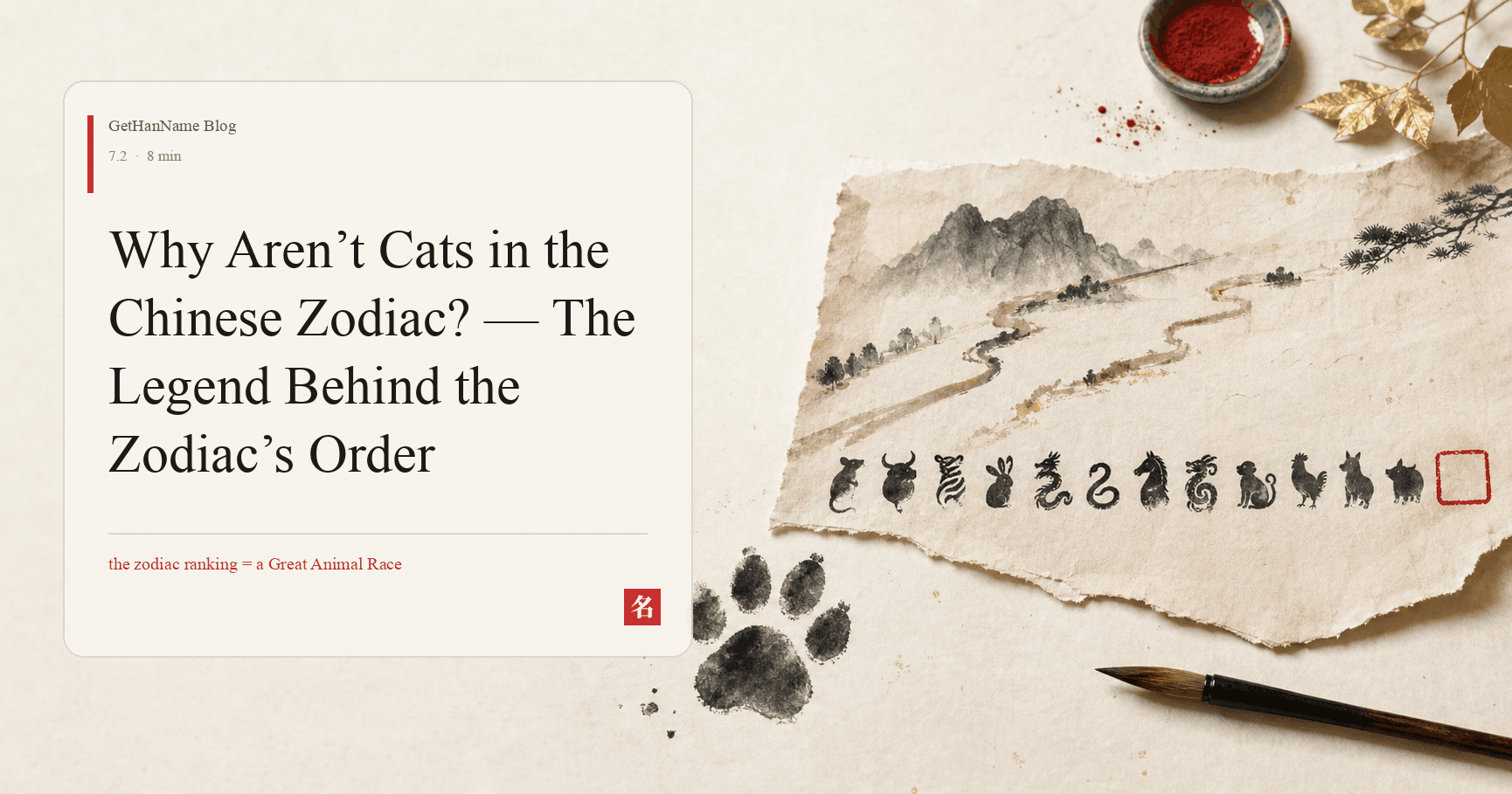
According to the most popular folk tale, the order of the twelve zodiac animals originated from “The Great Animal Race.” The Jade Emperor ordered the animals to race across a river, with the first to reach the other side securing a spot in the zodiac. The Rat hitched a ride on the Ox and jumped ahead just before reaching the shore to claim first place. Meanwhile, the Cat was tricked by the Rat, ended up in the water late, and missed out on the 12th position. This race not only explains the sequence “Rat, Ox, Tiger, Rabbit... Pig” but also accounts for why cats and rats are natural enemies — in short, the Cat lost more than just a race; it lost a friendship as well.
I. All Twelve Animals Are Here—Where’s the Cat?
In our previous article, “The Twelve Chinese Zodiac Signs: China’s Own ‘Constellation’ System,” we listed the twelve animals—rat, ox, tiger, rabbit, dragon, snake, horse, sheep, monkey, chicken, dog, and pig—and discussed their order as well as the celestial associations behind it. But you’ve likely noticed something odd:
The dog is included, the rat is included, even the legendary dragon is in the list—so where’s the cat?
Today, cats are among the most common pets in Chinese households. How could a culture that places “rat” first in the twelve zodiac signs ever forget about cats? This question has persisted for centuries, and the popular answer is quite vivid: because the cat lost a race. This is precisely the core analogy we’ll use in this article—the zodiac order equals The Great Animal Race. Below, we’ll take you through how this “thousand-year marathon” actually unfolded.
II. Exploring the Core Analogy: That Famous “River Crossing Race”
The most widely circulated folk legend goes like this:
A very long time ago, the Jade Emperor (Yùhuáng Dàdì), the supreme deity in Taoist mythology who rules the heavens, wanted to select twelve animals to name the years on Earth. He issued an imperial decree—all animals would participate in a river crossing race, and whichever one reached the other shore first would take the top spot, with the first twelve making up the list.
The two most notable characters in this story are the rat and the cat. Legend has it that they were once good friends. Knowing that its short legs wouldn’t allow it to swim across the river on its own, the rat decided to hitch a ride on the honest old ox—climbing onto its back and asking it to carry it across. The ox swam hard with its head down, seemingly about to be the first to reach the other side. Just as its nose was about to touch the shore, the rat leaped off and landed first—making it the winner by a narrow margin. The ox was stunned and could only settle for second place.
What about the cat? The most common version says that the cat loved to sleep in and asked the rat to wake it up, but the rat ran away on its own. By the time the cat reached the riverbank, all twelve spots had already been filled. There’s even a harsher version: the rat and cat were originally riding together on the ox’s back when the rat pushed the cat into the water halfway across. Since then, the cat missed out on becoming part of the zodiac and developed a lifelong feud with the rat—this is where the saying “cats chase rats” comes from.
How Did the Twelve “Competitors” Cross the River?
According to this legend, the order of the zodiac animals corresponds to their finishing positions in this race. Take a look at the table below—it clearly shows the rankings, the animals, and how they crossed the river:
| Rank | Animal (Pinyin) | How It Crossed the River |
|---|---|---|
| 1 | 鼠 (shǔ, Rat) | Secretly rode on the ox’s back and jumped off first upon reaching shore—the smartest “hitchhiker” |
| 2 | 牛 (niú, Ox) | Swam steadily at the front but was overtaken by the rat; despite its greatest effort, it ended up in second place |
| 3 | 虎 (hǔ, Tiger) | Forced its way across against the current with brute strength—nothing could stop it |
| 4 | 兔 (tù, Rabbit) | Lightly hopped across by stepping on stones or floating logs in the river |
| 5 | 龙 (lóng, Dragon) | Could have flown over, but stopped along the way to bring rain to Earth, which is why it ranks fifth |
| 6 | 蛇 (shé, Snake) | Slithered quietly around the horse’s hooves and appeared only after reaching shore |
| 7 | 马 (mǎ, Horse) | Ran at full speed but was startled by the snake under its feet, dropping to seventh place |
| 8 | 羊 (yáng, Goat) | Together with the monkey and chicken, they paddled across the river together using a raft |
| 9 | 猴 (hóu, Monkey) | Skillfully helped the goat and chicken steer the raft as the three reached shore together |
| 10 | 鸡 (jī, Rooster) | Found a raft and rowed desperately with its claws to reach the other side by hitching a ride |
| 11 | 狗 (gǒu, Dog) | Was originally a good swimmer but got distracted playing in the water along the way, arriving late |
| 12 | 猪 (zhū, Pig) | Got hungry and tired on the way, stopping to eat and sleep, ending up last |
- Rank
- 1
- Animal (Pinyin)
- 鼠 (shǔ, Rat)
- How It Crossed the River
- Secretly rode on the ox’s back and jumped off first upon reaching shore—the smartest “hitchhiker”
- Rank
- 2
- Animal (Pinyin)
- 牛 (niú, Ox)
- How It Crossed the River
- Swam steadily at the front but was overtaken by the rat; despite its greatest effort, it ended up in second place
- Rank
- 3
- Animal (Pinyin)
- 虎 (hǔ, Tiger)
- How It Crossed the River
- Forced its way across against the current with brute strength—nothing could stop it
- Rank
- 4
- Animal (Pinyin)
- 兔 (tù, Rabbit)
- How It Crossed the River
- Lightly hopped across by stepping on stones or floating logs in the river
- Rank
- 5
- Animal (Pinyin)
- 龙 (lóng, Dragon)
- How It Crossed the River
- Could have flown over, but stopped along the way to bring rain to Earth, which is why it ranks fifth
- Rank
- 6
- Animal (Pinyin)
- 蛇 (shé, Snake)
- How It Crossed the River
- Slithered quietly around the horse’s hooves and appeared only after reaching shore
- Rank
- 7
- Animal (Pinyin)
- 马 (mǎ, Horse)
- How It Crossed the River
- Ran at full speed but was startled by the snake under its feet, dropping to seventh place
- Rank
- 8
- Animal (Pinyin)
- 羊 (yáng, Goat)
- How It Crossed the River
- Together with the monkey and chicken, they paddled across the river together using a raft
- Rank
- 9
- Animal (Pinyin)
- 猴 (hóu, Monkey)
- How It Crossed the River
- Skillfully helped the goat and chicken steer the raft as the three reached shore together
- Rank
- 10
- Animal (Pinyin)
- 鸡 (jī, Rooster)
- How It Crossed the River
- Found a raft and rowed desperately with its claws to reach the other side by hitching a ride
- Rank
- 11
- Animal (Pinyin)
- 狗 (gǒu, Dog)
- How It Crossed the River
- Was originally a good swimmer but got distracted playing in the water along the way, arriving late
- Rank
- 12
- Animal (Pinyin)
- 猪 (zhū, Pig)
- How It Crossed the River
- Got hungry and tired on the way, stopping to eat and sleep, ending up last
💡 Cultural Note: This “River Crossing Race” is a folk legend that has been passed down for thousands of years, not part of official historical records. What makes it so fascinating is how it uses a heartwarming little story to weave together the personalities of these twelve animals, their relationships with one another, and even why “cats chase rats.”
III. Returning to Chinese Names: The “Number One” Ranking Also Influences Character Selection
You might wonder: What does a legendary competition have to do with choosing a Chinese name? The connection lies precisely in the word “first.”
Fang Lichen outlines the principles for naming those born in the Year of the Rat in his book Zhèng Míng Dào Xìng. He writes:
“The rat is the first of the twelve zodiac animals. As it ranks highest, it can be compared to a king, so names should include characters such as ‘王,’ ‘令,’ and ‘君.’”
—— Fang Lichen, Zhèng Míng Dào Xìng – An Authoritative Guide to Chinese Naming Traditions, Civil Aviation Press of China, 2007
See how it works? The ranking system serves as the basis for selecting characters. Since the rat holds the first place in the zodiac cycle, fortune-tellers believe people born under this sign “can be like kings,” making characters conveying regal qualities like ‘王,’ ‘令,’ and ‘君’ suitable choices. In other words, the order of the zodiac animals has subtly shaped how Chinese people choose their characters.
The absence of the cat also leads to a direct consequence: China has never had a “Year of the Cat,” and thus no traditional naming customs related to being born in the Year of the Cat. You may be born in the Year of the Rat, Ox, Tiger, or others—but you can never be born in the Year of the Cat. This is a fascinating example of how folklore has inadvertently shaped the boundaries of naming culture.
IV. Back to Reality: How This Story Endures Today
Once you grasp this “race,” the following scenarios will make much more sense:
Scenario 1: It’s one of the first stories every Chinese child hears. Almost all children in China first encounter the Twelve Chinese Zodiac animals through the version of “The Mouse Tricks the Cat.” Bedtime stories, picture books, animated shows—this narrative has served as a gateway to understanding the zodiac for countless people.
Scenario 2: The standard answer to “Why does the cat chase the mouse?” When children ask repeatedly why cats like to catch mice, adults usually respond with a smile, citing this legend: “Because the mouse pushed it into the water back then.” This tale not only explains the behavior of animals but also serves as an explanation for their natural instincts.
Scenario 3: “Another answer” offered by historians. However, beyond legends, scholars provide a more measured interpretation: When the Twelve Chinese Zodiac animals were formed (around the Spring and Autumn and Warring States periods), domestic cats likely had not yet truly entered Chinese daily life. The domestication and widespread adoption of cats in China occurred relatively late, while the pairing of the twelve Earthly Branches (Zi, Chou, Yin, Mao, etc.) with these animals was driven more by abstract logical principles—for example, “Zi hour” (from 11 p.m. to 1 a.m.) is when mice are most active, which is why “Zi” is paired with the mouse. In other words, the zodiac list may not have included a spot for cats from the very beginning.
💡 Cultural Note: Legends and scholarly research do not conflict here. One is a heartwarming origin myth, while the other represents rigorous historical study—each addresses different questions and can coexist peacefully. For ordinary people, the story of the cat losing the race remains far more relatable and enduring in everyday life than academic analyses.
V. Practical Tips for You
Whether you believe in legends or scholarly research, this story can add a layer of “cultural depth” to your Chinese name. Here are three simple steps:
- First, determine your zodiac sign. Just enter your birth year using a “chinese zodiac calculator” (for those born in January or February, make sure to check if the Lunar New Year has already passed that year).
- Learn about the “characteristic figures” associated with your zodiac sign. For example, if you are born in the Year of the Rat, knowing that rats rank “first” gives you a cultural basis for choosing characters like 王 or 君 in your name; if you are born in the Year of the Ox, since oxen symbolize those who make the greatest contributions, you might prefer characters that convey stability and reliability.
- Don’t worry about the absence of a Year of the Cat. The zodiac is just one cultural element to consider when choosing a name—there being no Year of the Cat doesn’t prevent you from having a beautiful Chinese name. Think of it simply as interesting background information.
Looking for a Chinese name that is truly “perfectly suited” to you, even one that takes into account zodiac stories? Feel free to try GetHanName—we don’t just translate your English name; we create a meaningful Chinese name tailored to your zodiac sign and personality.
6. Frequently Asked Questions (FAQ)
Q1: Is this “race across the river” story true?
It is a widely spread folk tale, not part of official historical records. Similar versions exist in the folk traditions of China, Vietnam, Japan, and other regions, with slight differences in details, but the core narrative—where the mouse finishes first while the cat is left out—remains consistent. Think of it as a charming origin myth.
Q2: The mouse clearly hitched a ride on the ox; why does it come in first?
This is precisely what makes the story so relatable—it focuses on the outcome, not the process. The mouse used its cleverness (or, some say, cunning tactics) to cross the finish line first, which according to the rules means it takes first place. While Chinese people often say the mouse has a short-sighted view, they also can’t deny its “resourcefulness,” and this legend captures that contradiction perfectly.
Q3: Are there other versions of this legend?
Yes. In some versions, the cat is forgotten by the mouse and fails to wake up, or it’s pushed into the water. In Vietnam’s zodiac system, the cat even replaces the rabbit—so the cat isn’t entirely absent from all zodiac cultures; it just isn’t part of China’s version.
Q4: Since cats are so common now, why isn’t there a “Year of the Cat”?
Because the zodiac is a fixed system based on the twelve Earthly Branches—Rat, Ox, Tiger... Pig—in a cycle of exactly 12 years that has been in use for over two thousand years. Adding the cat would require disrupting the entire timeline structure. No matter how popular cats are today, this list is unlikely to change.
Q5: If the cat isn’t part of the zodiac, will it affect my choice of a Chinese name?
Not at all. When choosing a name, you focus on your own zodiac sign (Rat, Ox, Tiger...), and whether the cat is included has nothing to do with you. You only need to pay attention to the animal associated with the year you were born and its preferred character roots.
VII. Further Reading
- 📖 The Twelve Chinese Zodiac Signs: China’s “Constellation” System (Series 7.1) — Want to first learn the complete order of the rat, ox, tiger, rabbit... and pig, along with their associations with Earthly Branches? This is the introductory article.
- 📖 Best Practices and Pitfalls in Naming Using Zodiac Signs: Dragons Love Water, Monkeys Adore Forests (Series 7.3) — Curious about which characters work well and which to avoid when naming based on your zodiac sign? This guide offers practical advice.
- 📖 What Are the Differences in Naming Between Those Born in the Year of the Dragon vs. the Year of the Tiger? (Series 7.5) — Using two popular zodiac signs, this article breaks down the logic behind naming according to the year.
References
- Fang Lichen, Zhèng Míng Dào Xìng – An Authoritative Guide to Chinese Naming Traditions, Civil Aviation Press of China, 2007. (It discusses principles such as “the rat is the first zodiac sign, and being ranked first allows it to be considered a king” in naming practices.)
- The “race across the river” story mentioned in this article is a widely spread folk legend; it is not directly recorded in the aforementioned book, so this note is provided for clarity. Historical explanations (such as when domestic cats were first tamed and the logic behind Earthly Branches) are summaries of commonly accepted academic views.
- The complete order of the zodiac signs and their associations with Earthly Branches (rat of Zi... pig of Hai) are based on information from Series 7.1.
This article is original content from GetHanName’s blog, first published on gethanname.com. Please contact us if you would like to reproduce it.
Related articles
Which Characters Should Be Avoided in Your Name Based on Your Zodiac Year?
Zodiac taboos are like “food allergies” — some character roots clash with your zodiac’s temperament, while others act as allergens. Using six representative animals—dragon, tiger, monkey, and rat—we explain which characters to choose and which to avoid when naming based on one’s zodiac.
The Twelve Chinese Zodiac Signs: China’s “Constellation” System
The Chinese zodiac is similar to the Western “constellation” system, but it is based on the year of birth with a cycle of 12 years. It uses a familiar Western analogy to explain the order of the Rat, Ox, Tiger, Rabbit, etc., and the pairing of earthly elements, as well as how this influences the selection of characters in Chinese names.